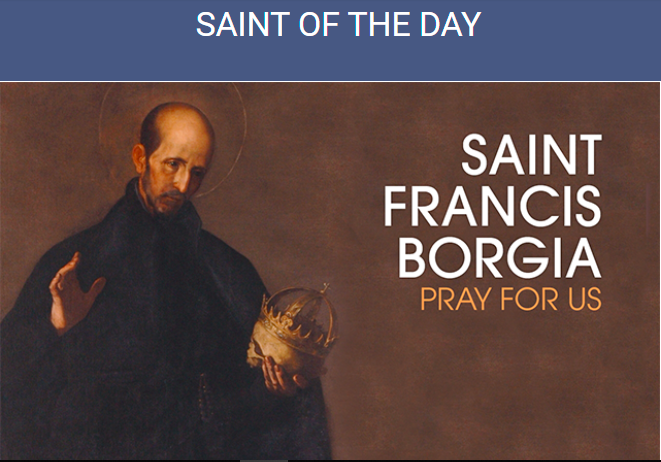
St. Francis Borgia (1510-1572) was born in Spain to a noble family, the son of a Duke. On his father’s side of the family he was the great-grandson of Pope Alexander VI, one of the notorious “Borgia Popes,” and on his mother’s side he was the great-grandson of King Ferdinand of Aragon. Francis joined the Spanish court of King Charles V at the age of 18, married, and had 8 children. In 1539 he experienced a profound religious conversion which caused him to renounce the pomp of the royal court, yet he continued his life of public service as the Viceroy of Catalonia. He made great progress in the spiritual life, and after his father’s death he became the Duke of Gandia. He built a university and invited the newly-founded Society of Jesus to work in his duchy. After the death of his wife, and after providing for his children, he joined the Jesuits in Rome and was given a prominent position in the order by St. Ignatius of Loyola. Under Francis’ leadership and reforms, the Jesuits advanced to such a great extent that he is considered to be their second founder. In the years following Ignatius’ death, Francis became head of the order and established Jesuit missions in multiple countries. He also counseled his missionaries in both practical strategies as well as spiritual discipline. St. Francis of Borgia was a celebrated preacher and a key figure in the Counter-Reformation movement. His feast day is October 10th.
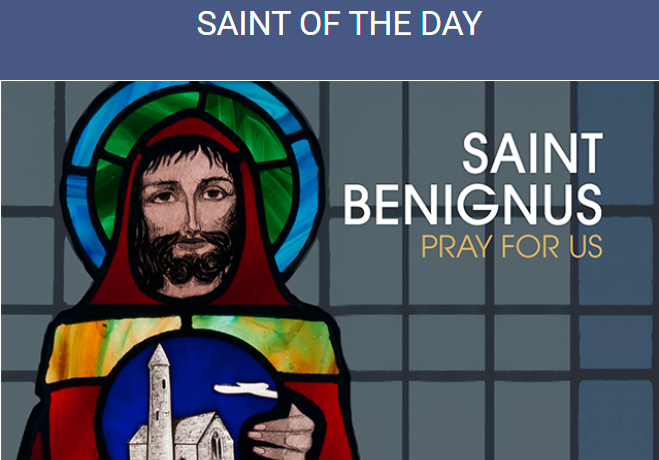
St. Benignus of Armagh (d. 467 A.D.) was the son of a pagan Irish chieftain in what is now County Meath in Ireland. He was baptized by St. Patrick and became his loyal follower in the saint’s ministry across Ireland. In 450 A.D. Benignus became coadjutor with St. Patrick in the Diocese of Armagh, and also became the first rector of the Catholic school there. St. Benignus was a talented singer and worked to form choral groups wherever they traveled for their missionary work; for this he was called “Patrick’s Psalmist.” He also assisted with the compilation of the Senchus Mor, the Irish Code of Law, and sat on a number of commissions, councils, and synods that helped further establish the Catholic faith across Ireland. His feast day is November 9th.
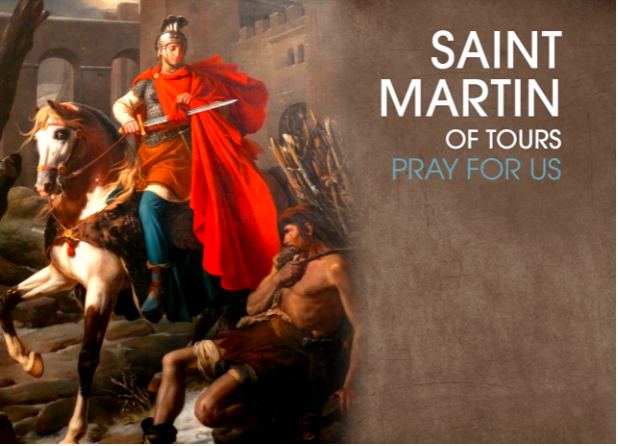
A conscientious objector who wanted to be a monk; a monk who was maneuvered into being a bishop; a bishop who fought paganism as well as pleaded for mercy to heretics—such was Martin of Tours, one of the most popular of saints and one of the first not to be a martyr.
Born of pagan parents in what is now Hungary, and raised in Italy, this son of a veteran was forced at the age of 15 to serve in the army. Martin became a Christian catechumen and was baptized when he was 18. It was said that he lived more like a monk than a soldier. At 23, he refused a war bonus and told his commander: “I have served you as a soldier; now let me serve Christ. Give the bounty to those who are going to fight. But I am a soldier of Christ and it is not lawful for me to fight.” After great difficulties, he was discharged and went to be a disciple of Hilary of Poitiers.
He was ordained an exorcist and worked with great zeal against the Arians. Martin became a monk, living first at Milan and later on a small island. When Hilary was restored to his see following his exile, Martin returned to France and established what may have been the first French monastery near Poitiers. He lived there for 10 years, forming his disciples and preaching throughout the countryside.
The people of Tours demanded that he become their bishop. Martin was drawn to that city by a ruse—the need of a sick person—and was brought to the church, where he reluctantly allowed himself to be consecrated bishop. Some of the consecrating bishops thought his rumpled appearance and unkempt hair indicated that he was not dignified enough for the office.
Along with Saint Ambrose, Martin rejected Bishop Ithacius’s principle of putting heretics to death—as well as the intrusion of the emperor into such matters. He prevailed upon the emperor to spare the life of the heretic Priscillian. For his efforts, Martin was accused of the same heresy, and Priscillian was executed after all. Martin then pleaded for a cessation of the persecution of Priscillian’s followers in Spain. He still felt he could cooperate with Ithacius in other areas, but afterwards his conscience troubled him about this decision.
As death approached, Martin’s followers begged him not to leave them. He prayed, “Lord, if your people still need me, I do not refuse the work. Your will be done.”
Reflection
Martin’s worry about cooperation with evil reminds us that almost nothing is either all black or all white. The saints are not creatures of another world: They face the same perplexing decisions that we do. Any decision of conscience always involves some risk. If we choose to go north, we may never know what would have happened had we gone east, west, or south. A hyper-cautious withdrawal from all perplexing situations is not the virtue of prudence; it is in fact, a bad decision, for “not to decide is to decide.”
St. Frances Xavier Cabrini (1850–1917) was the thirteenth child of a modest farming family born near Milan, Italy. Her father would often gather his children in the kitchen to hear him read from a book on the lives of the saints. St. Frances was endeared to the stories of missionaries working in the Orient and desired to become one herself, which in her day was a man’s role. Turned away from being a nun twice due to poor health, she prayed before the relics of her patron, Francis Xavier, the great Jesuit missionary-saint, about founding a new religious order to evangelize the East just as he did. Pope Leo XIII approved of her order, the Missionaries of the Sacred Heart, but instead of sending her to China as she had desired since childhood, he sent her to the West, specifically to America to serve the growing European immigrant population which faced poverty and disenfranchisement. St. Frances Xavier Cabrini moved to New York in 1889 and went on to found 67 institutions—schools, orphanages, and hospitals—throughout the Western Hemisphere. She received American citizenship, and in 1946 became the first United States citizen to be canonized by the Catholic Church. Her ministry left a significant mark on the Americas, creating lasting institutions to educate and care for those in need. She is the patron saint of immigrants, orphans, and hospital administrators. Her feast day is November 13th.
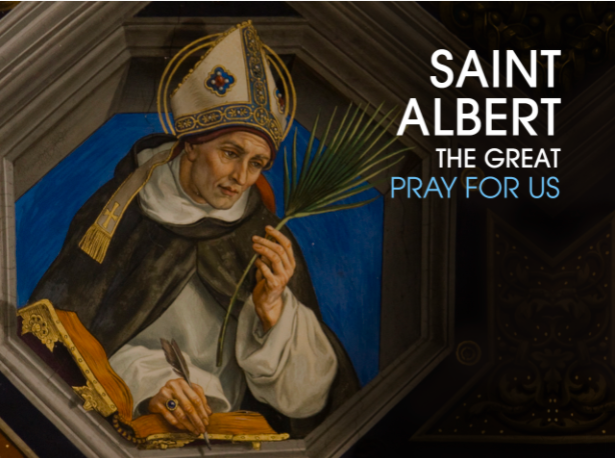
Albert the Great was a 13th-century German Dominican who decisively influenced the Church’s stance toward Aristotelian philosophy brought to Europe by the spread of Islam.
Students of philosophy know him as the master of Thomas Aquinas. Albert’s attempt to understand Aristotle’s writings established the climate in which Thomas Aquinas developed his synthesis of Greek wisdom and Christian theology. But Albert deserves recognition on his own merits as a curious, honest, and diligent scholar.
He was the eldest son of a powerful and wealthy German lord of military rank. He was educated in the liberal arts. Despite fierce family opposition, he entered the Dominican novitiate.
His boundless interests prompted him to write a compendium of all knowledge: natural science, logic, rhetoric, mathematics, astronomy, ethics, economics, politics, and metaphysics. His explanation of learning took 20 years to complete. “Our intention,” he said, “is to make all the aforesaid parts of knowledge intelligible to the Latins.”
He achieved his goal while serving as an educator at Paris and Cologne, as Dominican provincial, and even as bishop of Regensburg for a short time. He defended the mendicant orders and preached the Crusade in Germany and Bohemia.
Albert, a Doctor of the Church, is the patron of scientists and philosophers.
Reflection
An information glut faces us Christians today in all branches of learning. One needs only to read current Catholic periodicals to experience the varied reactions to the findings of the social sciences, for example, in regard to Christian institutions, Christian life-styles, and Christian theology. Ultimately, in canonizing Albert, the Church seems to point to his openness to truth, wherever it may be found, as his claim to holiness. His characteristic curiosity prompted Albert to mine deeply for wisdom within a philosophy his Church warmed to with great difficulty.
Saint Albert the Great is a Patron Saint of:
Educators/Teachers Medical Technicians Philosophers Scientists
Saint Teresa of Calcutta once said, “We cannot all do great things. But we can do small things with great love.” The reality is that most of our lives are made up of seemingly small decisions and yet they do truly matter in how we are to be judged.
Today, Fr. Mike shares how our faithfulness to God in the small daily decisions actually amounts to the sum of our spiritual life and the growth in our holiness.
What does God want this Advent? Simple. He wants you. He wants a personal encounter with you. This year, journey through Advent with “Rejoice! Finding Your Place in the Advent Story,” and learn about the places, people, and events that shaped the story of the very first Advent and shape our own lives today: https://tinyurl.com/yz6yy5pz
Gospel: Mark 12:38-44 The month of November can be classified as a study in Ecclesiology or Who the Church is. You can read about bishops referring to the Church as a “what.” But it’s a “Who.” “Father, why do you say that? How can you contradict a bishop?” I like contradicting bishops. . . it’s a hobby. When Paul was going around beating people up, Jesus said “Saul, why do you persecute Me?” He didn’t say, “Why are you persecuting My institution.” No. He said, “Why do you persecute Me.” The Church is a “Who.” It’s the body of Christ. There are aspects of a “what” but it’s a “Who.”
What brought the Church in to being? I’ll give you the answer by asking my second question. What brought you in to being? It wasn’t a “what” – it was a “Who.” God’s love. The first question in the Catechism is “Why did God make you?” Because He loved you. You were created out of love. You have always been in the mind of God for all eternity. We existed in the mind of God before we existed in the bodies of our mothers. God created us out of love and sustains us out of love. He calls us into His presence out of love. He calls us into His church out of love. This is His gift of love so that we can become one with the Body of Christ. . . His Bride. So, the Church is not a “what.” It’s a “Who.” It is the Bride of Christ.
Some people try to change the Church. If it’s an institution you can change it, but if it’s a “Who,” you can’t. The Church is a “Who.” That “Who” was formed out of love, sustained and created out of love, and exists only because of love. It’s a love of all people in the world and not just those here in Albemarle even though we love it here . . . it’s the best parish in the diocese. Don’t tell them that – they will get really upset. I almost get into fights with other priests when they tell me how great their parish is. Really? The whole Church is united by baptism. As Bishop Waters said, there are no hyphenated Catholics. We are united in love, and we come to express our love and our prayers for those who have gone before us. As we pass from this world, those left behind will pray for us, and the cycle of love will continue.
Our love of others gave us what we have. We didn’t build or pay for this church. The Church of the Annunciation in New York gave the money to build it. So, Yankees built this church. We are enjoying their gifts of love and the gifts of love by those in this parish who have gone on before us. The saints who have gone on before us pray for us. They give us that gift of love. They intercede for us to the Father so that we can attain what they have. Love is not fulfilled unless it is complete. No mother is happy unless she has her family around her. The saints want their spiritual family, the whole body of the Church, to be with them in Heaven. They always pray for us. We as the Church Militant, the Church working for our salvation, pick up our crosses each day and follow the good Lord. We pray for those who can’t. . .those who have gone before us and who are cleaning their baptismal robes so that they may come and dwell in the place of the Perfect. This is mentioned at every Mass. When we pass away, the Church will pray for us, maybe not by name, but they will always pray for us. You were given the gift of love not by your prayers but by this prayer. Because the Holy Sacrifice of the Mass is what? You got me on that one. It’s not a “what.” It’s a “Who.”
In some churches, they announce that “the liturgy will be celebrated…” That’s a Greek word meaning a public act. Big deal. They think they are really hip. The Holy Sacrifice of the Mass is Christ offering Himself to the Father. And Christ, in that offering, is made present on the altar. He asks not for our participation. This is where the catechetics of the Mass have gotten really weird over the years. The terms we use when referring to the Mass are often blasphemous. “We go to church.” Yeah. You walk in and walk back out. Big deal. “I attend church.” Well, I attend a play. “I actively participate.” You know, I have a degree in Philosophy, believe it or not, and I have paperwork to prove it. But I have no idea what that phrase means. It was made up in the last forty years, and it means absolutely nothing. So, when I say Mass in hospitals and nursing homes for people who are barely conscious and heavily medicated, they aren’t actively participating? During my 13-minute Mass in the field, when the natives were restless, we didn’t sing, but we prayed a lot. Are you kidding me? They were trying to kill Blanch and John’s little boy. You do not actively participate. You do not go to Mass. You do not attend Mass. Take what I’m about to tell you and commit it to memory. You are called, when you come here, to become part of Christ’s sacrifice. Whether we sing or not and whether we take up a collection or not has nothing to do with it. You are called to become part of the sacrifice of Christ. The Romans participated in the crucifixion, but they didn’t actually suffer with Christ, did they? You take the place of the Blessed Mother whose human nature Christ took and suffered with on the Cross and redeemed us with. You take the place of Saint John the Apostle, the Beloved, who suffered with Christ out of love. You take the place of Mary Cleophas. You are suffering with Christ. You unite your sufferings and human nature with the suffering of Christ. In the offertory, the priest, acting in the person of Christ, takes your human natures and makes them one with Christ in that animation of love on the altar that is always present to the Following. You become part of Christ’s sacrifice. That is why this place is so special. Not only is there the Real Presence of our Lord in the Most Blessed Sacrament, but you are also standing at the foot of the Cross. And very shortly you will become part of Christ’s sacrifice. At Mass, you will receive the grace of offering yourself. You may offer that grace to one of your departed brethren. The grace of receiving Holy Communion is another one. Even if you are not able to receive the Most Precious Body and Blood of our Lord Jesus Christ, you can offer that sense of deprivation to someone else.
This month, we pray for those who have gone before us. The Church always prays for the departed. . . always. The Protestants, with their so-called reformation say, “We don’t pray for the dead.” Yeah, well we do. It’s a part of the Church. The Catacombs are filled with inscribed prayers in Latin. What do they say? “Pray for me.” Since the earliest days of the Church, for over 2,000 years, we have prayed for them. This is what we do. When our loved ones are all in Heaven, with mine it may take a little work, but when they are all in Heaven, then our prayers go to someone else who needs them. Remember that old Italian saying: “I remember your name.” The saints all know who to pray for because when they get to Heaven, they are enlightened by the transfiguration. They know who helped them, and they will mention you by name to the ear of Christ.
Father’s Afterthoughts:
Veterans Day is this week. There are a lot of people who served, but just because they served doesn’t make them heroes. In my day, people served because they didn’t want to go to jail or to go to Canada and learn to speak French. I wouldn’t want to share a foxhole with them. They might get me killed. But there are a lot of unknown heroes. I hear a lot of stories from veterans at the VA Hospital, and I’m going to tell you about two heroes. One of the vets asked me if I served in Vietnam, and I told him “No.” This vet told me that his older brother volunteered for Vietnam so he wouldn’t have to go. His brother was a hero. Another veteran, who is 99 years old and in Hospice, has all his faculties. . . he just can’t see very well. This veteran was in the Armored Division during World War II and had a job nobody wanted. . . Radio Telephone Operator or RTO. They were the ones the enemy was told to take out first. Your lifespan as an RTO wasn’t that great. To make matters worse, you carried a big antenna which let everybody know exactly where you were. Thank you! The good side of being the RTO is that he got to ride in a half-track and didn’t have to walk all the way to Berlin. His unit liberated Dachau; the first concentration camp established in Germany. Those are the veterans you should pray for and honor.
How will you apply this message to your life?
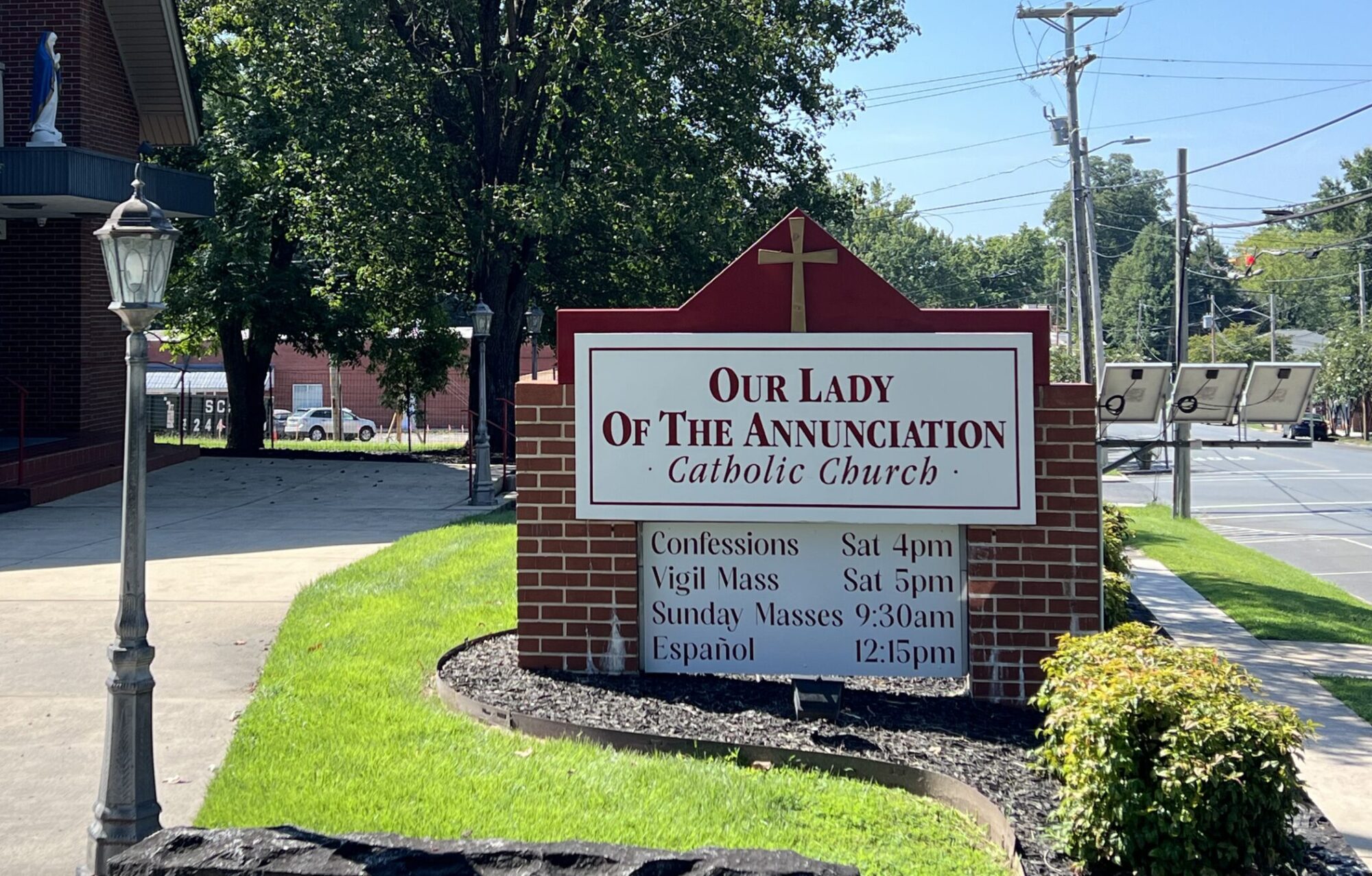
You can read all of Father Fitzgibbons’ sermons by going to annunciationcatholicalbemarle.com/, clicking on “Blog” then “Categories” and then “Sermon Notes.” They can also be found on Facebook by searching for “Our Lady of the Annunciation Albemarle”
God is quick to forgive, and he’s given us the gift of confession so we can return to a relationship with him after sin. But this love he has for us is so great that he never wants us to be caught by sin again, which is why he allows our sins to have consequences. Just like your parents would teach you why something is wrong, God helps us build knowledge of sin and its consequences by letting us experience them. Without learning from our mistakes, we would just keep falling into the same sins, separating us from a relationship with God.
Today, Fr. Mike explains why God lets us learn from our mistakes, and how it shows the depth of his mercy.
Even with four hours a day of prayer, Fr. Malachy still gets distracted.
After his mind would wander off on one tangent after another, he brought this problem to his spiritual director. But, the director told him, God took great joy in seeing Fr. Malachy turn to him over and over again, choosing Jesus tangent after tangent.
A great analogy for distraction in prayer is a baby learning to walk. The baby is going to fall over and over again, but the parents triumph in every step the baby takes because they know how hard it is for the baby to overcome the obstacles and master the challenge of walking. In prayer, we are going to get distracted over and over, but the Lord is overjoyed by every moment where we turn back to him because he knows how hard the world, the flesh, and the devil make it to pray.
When you get distracted, just get up and turn back to Jesus. Eventually focusing on him will become as easy as walking. After a while, you will begin to learn to turn your heart to Jesus naturally and choose him instead of distraction.
Slow down your mind. Instead of fighting distraction after distraction, take each step slowly. An occasional “squirrel” may cross your mind, but you will be able to refocus on Jesus if you take it slow. Then, before you know it, you won’t just be walking to Jesus in your prayer. You’ll be able to run to him and with him.
With that, Fr. Malachy says farewell and offers you his blessing as he travels to Nicaragua to continue his mission with the CFRs there. This may be his last video on Ascension Presents.
Growing up Fr. Mike thought prayer should be like soaking in a hot tub. He didn’t understand why it was so hard when he tried it.
It took him a while to learn that, as the Catechism says, prayer is a gift of grace and a determined response on our part. Prayer always presupposes effort. There’s always some kind of engagement when we properly pray to God. It’s not just about soaking in God’s grace. The required effort in prayer is difficult more often than it is not. Prayer is a battle against ourselves and “the wiles of the tempter who does all he can to turn man away from prayer” (CCC 2725).
Over time, Fr. Mike discovered that prayer needs to be more than a momentary time where we seek solace and closeness with God. We need to constantly acknowledge our relationship with God throughout the day, just as a husband and wife are constantly thinking of each other. Then when we do set aside time to simply be with God, it happens more naturally.
If you want to improve your prayer life, make the intentional and faithful decision to live the same way outside of prayer as you do within prayer.
Read “The Battle of Prayer” section in the Catechism.