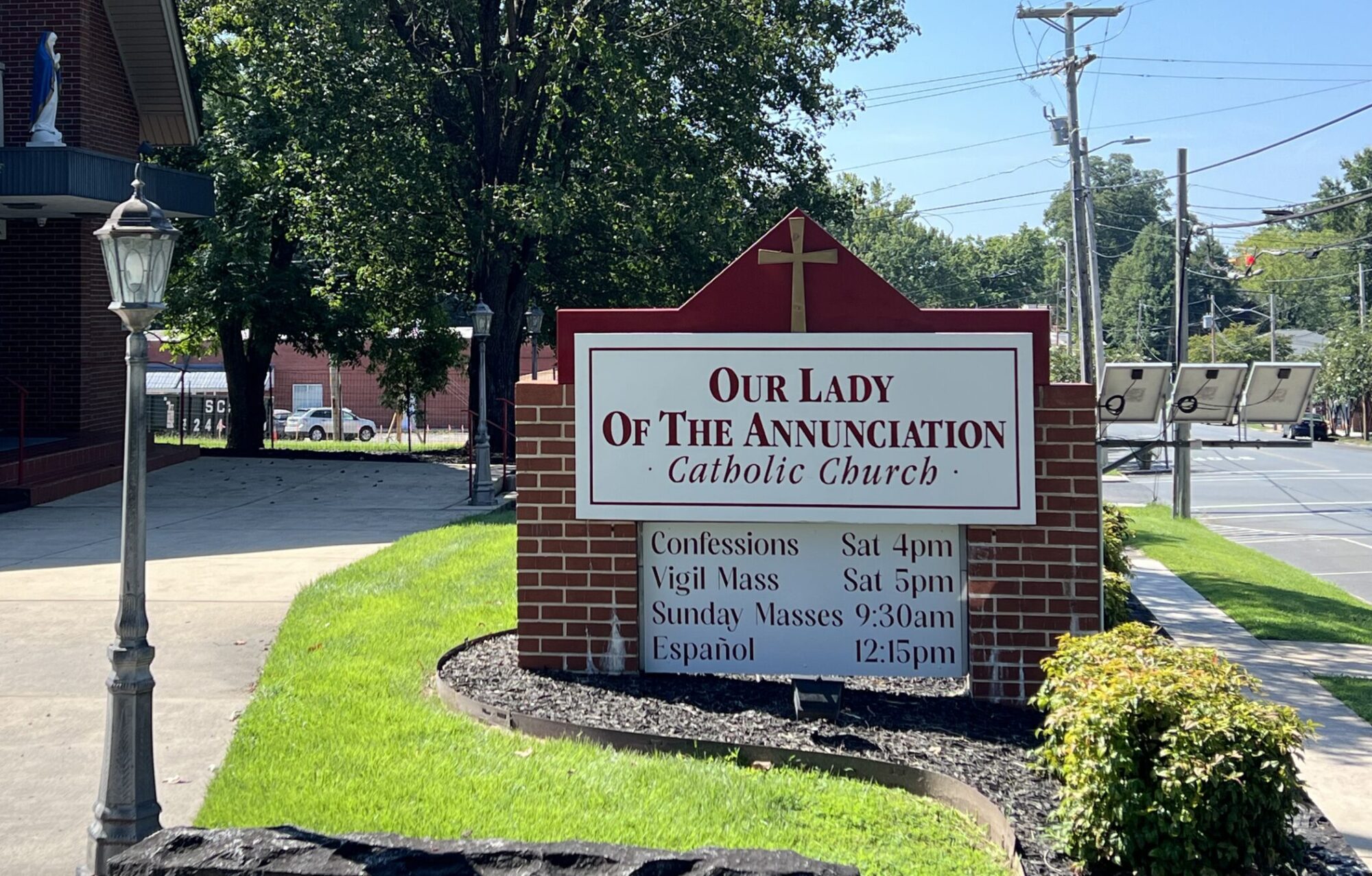
Saint of the Day – March 25 – Annunciation of the Lord

The Story of the Annunciation of the Lord

The feast of the Annunciation, now recognized as a solemnity, was first celebrated in the fourth or fifth century. Its central focus is the Incarnation: God has become one of us. From all eternity God had decided that the Second Person of the Blessed Trinity should become human. Now, as Luke 1:26-38 tells us, the decision is being realized. The God-Man embraces all humanity, indeed all creation, to bring it to God in one great act of love. Because human beings have rejected God, Jesus will accept a life of suffering and an agonizing death: “No one has greater love than this, to lay down one’s life for one’s friends” (John 15:13).

Mary has an important role to play in God’s plan. From all eternity, God destined her to be the mother of Jesus and closely related to him in the creation and redemption of the world. We could say that God’s decrees of creation and redemption are joined in the decree of Incarnation. Because Mary is God’s instrument in the Incarnation, she has a role to play with Jesus in creation and redemption. It is a God-given role. It is God’s grace from beginning to end. Mary becomes the eminent figure she is only by God’s grace. She is the empty space where God could act. Everything she is she owes to the Trinity.

Mary is the virgin-mother who fulfills Isaiah 7:14 in a way that Isaiah could not have imagined. She is united with her son in carrying out the will of God (Psalm 40:8-9; Hebrews 10:7-9; Luke 1:38).

Together with Jesus, the privileged and graced Mary is the link between heaven and earth. She is the human being who best, after Jesus, exemplifies the possibilities of human existence. She received into her lowliness the infinite love of God. She shows how an ordinary human being can reflect God in the ordinary circumstances of life. She exemplifies what the Church and every member of the Church is meant to become. She is the ultimate product of the creative and redemptive power of God. She manifests what the Incarnation is meant to accomplish for all of us.

Reflection

Sometimes spiritual writers are accused of putting Mary on a pedestal and thereby, discouraging ordinary humans from imitating her. Perhaps such an observation is misguided. God did put Mary on a pedestal and has put all human beings on a pedestal. We have scarcely begun to realize the magnificence of divine grace, the wonder of God’s freely given love. The marvel of Mary—even in the midst of her very ordinary life—is God’s shout to us to wake up to the marvelous creatures that we all are by divine design.

The Catechism in a Year – Day 82 – Jesus and the Law

What is Jesus’ relationship with the Old Testament Law? Our Catechism readings today reveal that Jesus is the Author of the Law who provides the definitive interpretation of the Law. We learn that Jesus did not come to abolish the Law but rather to fulfill the Law in its totality. Fr. Mike also clarifies the difference between Temple Laws, Kingdom Laws, and Moral Laws in Scripture. Today’s readings are Catechism paragraphs 577-582.

Click on the link to play video: https://youtu.be/rkXEfUE5c5I


The Catechism in a Year – Day 81 – Christ’s Paschal Mystery

Fr. Mike begins his examination of the Paschal Mystery of Christ’s passion, death, and ultimate Resurrection. He emphasizes that all of Scripture points to this Paschal Mystery, and that through our faith, we can try to examine the circumstances of Jesus’ life to fully understand our own redemption. We also explore Jesus’ relationship with Israel and our own relationship with our Jewish forefathers. Today’s readings are Catechism paragraphs 571-576.

Click on the link to play video: https://youtu.be/Imp5kfJ-V_g


The Catechism in a Year – Day 80 – Summary of the Mysteries of Christ’s Life

We have arrived at another nugget day, or In Brief day, for the paragraphs on the mysteries of Christ’s life. On today’s “mystery nugget” day, Fr. Mike recounts the significance of Christ’s obedience to the Father and our own obedience to God’s will. He also emphasizes the importance of reflecting on the mysteries of Christ’s life by reading and meditating on the Gospels and praying the Rosary. Today’s readings from the Catechism are paragraphs 561-570.


The Catechism in a Year – Day 79 – Jesus’ Transfiguration and Messianic Acts

Together, with Fr. Mike, we explore both the mystery of Christ’s Transfiguration and the mystery of his messianic entrance into Jerusalem. We examine how the Transfiguration reveals that Christ’s death was a voluntary act, and that he is truly the “splendor of the Father.” Fr. Mike emphasizes the incredible parallel between Christ’s baptism and Transfiguration. That, on the threshold of his public life, we witness Christ’s baptism, and on the threshold of the Passion, we witness the Transfiguration. Today’s readings are Catechism paragraphs 554-560.

Click on the link to play video: https://youtu.be/Rc30dQHmg7A


The Catechism in a Year – Day 78 – Signs of the Kingdom

Fr. Mike unpacks the signs of the kingdom of God that Christ performed while on Earth. These signs of the kingdom are a way for us to see that Jesus is not just “another prophet” but is, in fact, the Son of God. Fr. Mike reminds us that these miracles and signs can strengthen the faith, but they can also be opportunities for “offense.” We also examine the authority that Christ entrusts to St. Peter, and his unique role within the college of apostles, just like the unique role the Holy Father has within the Church today. Today’s readings are Catechism paragraphs 547-553.

Click on link to play video: https://youtu.be/k1HqrA0u7Q0


Saint of the Day – March 23 – Saint Turibius of Mogrovejo


Saint Turibius of Mogrovejo’s Story (November 16, 1538 – March 23, 1606)

Together with Rose of Lima, Turibius is the first known saint of the New World, serving the Lord in Peru, South America, for 26 years.

Born in Spain and educated for the law, he became so brilliant a scholar that he was made professor of law at the University of Salamanca and eventually became chief judge of the Inquisition at Granada. He succeeded too well. But he was not sharp enough a lawyer to prevent a surprising sequence of events.

When the archdiocese of Lima in Peru required a new leader, Turibius was chosen to fill the post: He was the one person with the strength of character and holiness of spirit to heal the scandals that had infected that area.

He cited all the canons that forbade giving laymen ecclesiastical dignities, but he was overruled. Turibius was ordained priest and bishop and sent to Peru, where he found colonialism at its worst. The Spanish conquerors were guilty of every sort of oppression of the native population. Abuses among the clergy were flagrant, and he devoted his energies and suffering to this area first.

He began the long and arduous visitation of an immense archdiocese, studying the language, staying two or three days in each place, often with neither bed nor food. Turibius confessed every morning to his chaplain, and celebrated Mass with intense fervor. Among those to whom he gave the Sacrament of Confirmation was the future Saint Rose of Lima, and possibly the future Saint Martin de Porres. After 1590, he had the help of another great missionary, Francis Solanus, now also a saint.

Though very poor his people were sensitive, dreading to accept public charity from others. Turibius solved the problem by helping them anonymously.

Reflection
The Lord indeed writes straight with crooked lines. Against his will, and from the unlikely springboard of an Inquisition tribunal, this man became the Christlike shepherd of a poor and oppressed people. God gave him the gift of loving others as they needed it.