“What the soul is to the human body, the Holy Spirit is to the Body of Christ, which is the Church.” The Catechism uncovers how the Holy Spirit truly builds up the whole Church in the name of Jesus. Fr. Mike dives into the incredibly diverse gifts that the Holy Spirit gives up for the building up of the Kingdom—the charisms. Today’s readings are Catechism paragraphs 797-810.
Christ is the head of the Church. The Catechism describes Jesus’ relationship to his Church as “a personal relationship…expressed by the image of bridegroom and bride.” Fr. Mike points out how important this is by reminding us that, underneath all of the doctrine and the dogma, God is madly in love with you. If we always remember this love, everything else will fall into place. Today’s readings are Catechism paragraphs 792-796.
“The Church is communion with Jesus.” The Catechism shows us what it means for the Church to be considered the “body of Christ”. Fr. Mike explains how being part of the Church makes us “united in him, in his body”—more intimately connected with Jesus than even the Apostles were. Today’s readings are Catechism paragraphs 787-791.
God draws people to himself and makes them his own. The Catechism shows us what makes God’s people different from everyone else, and what it is that unites them. Fr. Mike hones in on what exactly it is that the People of God do, and exhorts us to start doing that right here, today. Today’s readings are Catechism paragraphs 781-786.
Do we love the Church? Some of us might struggle with that idea, but Fr. Mike explains that if we are to love and live in accordance with the heart of Jesus, we must love what he loves. Jesus, the bridegroom, loves his bride, the Church, so we must love the Church. We also learn that the sacraments are not only signs but also the very instruments by which the Holy Spirit gives us the grace of Christ. Today’s readings are Catechism paragraphs 772-780.
Saint Gianna Beretta Molla’s Story (October 4, 1922 – April 28, 1962)
In less than 40 years, Gianna Beretta Molla became a pediatric physician, a wife, a mother and a saint!
She was born in Magenta near Milano, the tenth of Alberto and Maria Beretta’s 13 children. An active member of the St. Vincent de Paul Society and a leader in the Catholic Action movement, Gianna also enjoyed skiing and mountain climbing. She earned degrees in medicine and surgery from the University of Pavia, eventually specializing in pediatrics. In 1952, Gianna opened a clinic in the small town of Mesero, where she met engineer Pietro Molla.
Shortly before their 1955 marriage, Gianna wrote to Pietro: “Love is the most beautiful sentiment that the Lord has put into the soul of men and women.” In the next four years the Mollas had three children: Pierluigi, Mariolina, and Laura. Two pregnancies following ended in miscarriage.
Early in her final pregnancy, doctors discovered that Gianna had both a child and a tumor in her uterus. She allowed the surgeons to remove the tumor but not to perform the complete hysterectomy that they recommended, which would have killed the child. Seven months later in April 1962, Gianna Emanuela Molla was born at the hospital in Monza, but post-operative complications resulted in an infection for her mother. The following week Gianna Molla died at home, and was buried in the cemetery of Mesero.
Gianna Emanuela went on to become a physician herself. Gianna Beretta Molla was beatified in 1994 and canonized 10 years later. Her liturgical feast is celebrated on April 28.
Reflection
With great faith and courage, Gianna Molla made the choice that enabled her daughter to be born. We can often wish that we were in different circumstances, but holiness frequently comes from making difficult choices in bad situations.
If you read the Acts of the Apostles, you learn that the Church is to evangelize by using prayers, the Mass, and the Breaking of the Bread. Further along in the Gospels, Saint Paul said, “We preach Christ crucified” (1 Corinthians 1:23). We don’t need to reinvent the wheel, which is what we always seem to do because we think we have a better way. But it never quite works out, does it. And it is painful and expensive on your part. I had confirmation of this on Friday while I was having breakfast at a restaurant. This man came up to me and said, “Excuse me. I have to apologize because I didn’t know how to properly address you, so I asked someone, and they said to call you ‘Father’.” Well, thank you! That man was a Marine who was awarded two purple hearts in Vietnam because he was wounded in combat. I was really impressed. But the compliment wasn’t to me . . . it was to my Boss. So, we must be doing something right here.
We also want to pass all sorts of laws about inanimate objects. Really? How did that work out during Prohibition? Not too well. The problem is not an inanimate object; it’s a person. Do you know what the most common murder weapon is? A knife. So, unless you want to gnaw on your food instead of using a knife, don’t ask for more laws. You have to change the person and not the inanimate object. That’s why we must pass along the Faith.
Now because it is Divine Mercy Sunday, I will ask you a question and it may frighten you. What does our Lord want most from you when you come to church? Don’t reach for your wallets. Churches always say, “We need your time, talent, and treasure.” When you hear that, it’s fertilizer and I’m being really, really nice. He can do without all of that because He is God. You know what Christ wants? He wants the worst you have . . . He wants your sins. He didn’t come down from the Cross and say, “I want your time, talent, and treasure.” But He cannot forgive our sins unless we say, “God, I’m sorry. This is what I have done.” He will ask you to tell a priest who, according to the Gospels, acts in persona Christi. God is all-powerful, but the one thing that He will not do is take your sins from you until you give them to Him. He will not violate your free will.
God gave the power to priests and bishops to celebrate the Mass and the Sacrifice of Christ which produces the Sacraments. The apostles were told, “I will give you the keys of the Kingdom of Heaven, and whatever you bind on earth shall be bound in Heaven, and whatever you loose on earth shall be loosed in Heaven” (Matthew 16:19). But how do we know the difference? It’s a good question. Well, what are the three conditions for repentance? Contrition, amendment, and the avoidance of sin. Sin will find you. So, if you don’t want to drink, don’t go into a bar. There is always someone who will hand you a beer. You cannot prevent everything but that’s the purpose of amendment. If you are shacking up, you can’t be forgiven unless you say, “Hey, I’m moving out.” Otherwise, you are just wanting permission. But our Lord won’t take your sins unless you agree with Him.
Now, the morals course I took consisted of two volumes of textbooks which we were tested on. I also go to FU (Felon University) for refresher courses. So, if you have committed a sin I haven’t heard during all my years of hearing confessions, I will name it after you. You will be famous! You’ll become an “influencer,” get on You-Tube, and make some bucks. But you’re not that original . . . none of us are. That’s the guilt, shame, fear, and remorse that sin does to us. But once we get rid of all that garbage we hold so dear, God will give us His Most Precious Blood that flowed from His pierced side on the Cross and which fills the chalice at every Mass so that we may have peace in our souls. During the Sacrament of Penance, the priest anoints our soul with His Most Precious Blood for the forgiveness of sin. Our Lord came to reconcile us to Him so that we may have life and have it to the fullest. He didn’t come to so that He could use our time, talent, treasure and all that propaganda doodoo. He wants your sins.
Take advantage of God’s love. Give Him the worst that you’ve got . . . give Him your sins. I cannot force you although I’d like to, but I can’t. The greatest experience of God’s love is His mercy. God is always offering us His great gift of love. So, take advantage of it. We make our lives a lot harder than they need to be, which makes the lives of those around us a lot harder than they should be.
Father’s Reflections . . .
An interesting thing happened to me yesterday. I did a baptism and the mother and godmother asked, “Father, do you remember us?” Um, would it hurt your feelings if I said ‘no’? Nothing personal. They said, “You baptized both of us.” Oh God. I’m getting old. I baptized the parents and now I’m baptizing the kids. I’ve been here a long, long time. With therapy, you’ll get over it. People ask, “Father, when you retire, will you move back north to be with your family?” My family is in the cemetery, but I’ll be there soon enough.
How will you apply this message to your life? _______________________________
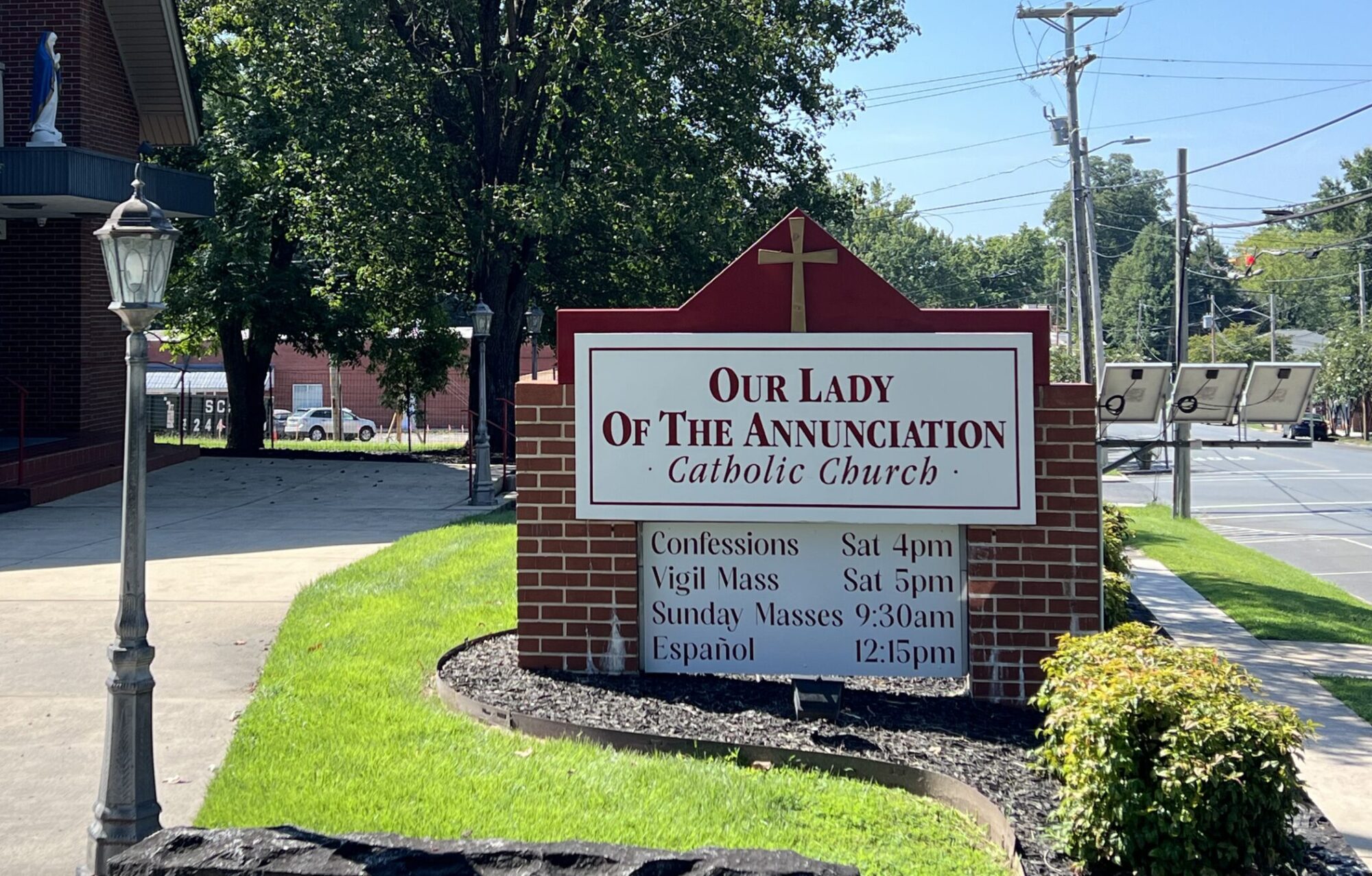
You can read all of Father Fitzgibbons’ sermons by going to annunciationcatholicalbemarle.com and clicking on “Blog” then “Categories” then “Sermon Notes.” On a cell phone: click on “Blog” then “Menu” and then “Categories.” Sermon Notes are also available on the church Facebook page at facebook.com/ola.catholic.church. Click on “Groups” and then “Sermon Notes.”
Jesus Christ established the Church, but the Holy Spirit continually sanctifies the Church with wisdom, guidance, and charismatic gifts. The Church’s mission is to proclaim and establish the beginning of God’s Kingdom on earth, and we participate in this mission through charity, humility, and self-denial. Fr. Mike helps us understand the seemingly paradoxical idea that the Church is visible and spiritual, both human and Divine. Today’s readings are Catechism paragraphs 767-771.