Saint of the Day – May 24 – Saint Mary Magdalene de’ Pazzi

Saint Mary Magdalene de’ Pazzi’s Story (April 2, 1566 – May 25, 1607)

Mystical ecstasy is the elevation of the spirit to God in such a way that the person is aware of this union with God while both internal and external senses are detached from the sensible world. Mary Magdalene de’ Pazzi was so generously given this special gift of God that she is called the “ecstatic saint.”

Catherine de’ Pazzi was born into a noble family in Florence in 1566. The normal course would have been for her to have married into wealth and enjoyed comfort, but Catherine chose to follow her own path. At 9, she learned to meditate from the family confessor. She made her first Communion at the then-early age of 10, and made a vow of virginity one month later. At 16, Catherine entered the Carmelite convent in Florence because she could receive Communion daily there.

Catherine had taken the name Mary Magdalene and had been a novice for a year when she became critically ill. Death seemed near, so her superiors let her make her profession of vows in a private ceremony from a cot in the chapel. Immediately after, Mary Magdalene fell into an ecstasy that lasted about two hours. This was repeated after Communion on the following 40 mornings. These ecstasies were rich experiences of union with God and contained marvelous insights into divine truths.

As a safeguard against deception and to preserve the revelations, her confessor asked Mary Magdalene to dictate her experiences to sister secretaries. Over the next six years, five large volumes were filled. The first three books record ecstasies from May of 1584 through Pentecost week the following year. This week was a preparation for a severe five-year trial. The fourth book records that trial and the fifth is a collection of letters concerning reform and renewal. Another book, Admonitions, is a collection of her sayings arising from her experiences in the formation of women religious.

The extraordinary was ordinary for this saint. She read the thoughts of others and predicted future events. During her lifetime, Mary Magdalene appeared to several persons in distant places and cured a number of sick people.

It would be easy to dwell on the ecstasies and pretend that Mary Magdalene only had spiritual highs. This is far from true. It seems that God permitted her this special closeness to prepare her for the five years of desolation that followed when she experienced spiritual dryness. She was plunged into a state of darkness in which she saw nothing but what was horrible in herself and all around her. She had violent temptations and endured great physical suffering. Mary Magdalene de’ Pazzi died in 1607 at age 41, and was canonized in 1669. Her liturgical feast is celebrated on May 25.

Reflection

Intimate union, God’s gift to mystics, is a reminder to all of us of the eternal happiness of union he wishes to give us. The cause of mystical ecstasy in this life is the Holy Spirit, working through spiritual gifts. The ecstasy occurs because of the weakness of the body and its powers to withstand the divine illumination, but as the body is purified and strengthened, ecstasy no longer occurs. See Teresa of Avila’s Interior Castle, and John of the Cross’ Dark Night of the Soul, for more about various aspects of ecstasies.

Sermon Notes – May 21, 2023 – The Apostles’ Last Sight of Christ

The Apostles’ Last Sight of Christ

Father Peter Fitzgibbons

May 20 – 21, 2023

Gospel:  John 17:1-11

1 After saying this, Jesus raised His eyes to Heaven and said: Father, the hour has come: glorify Your Son so that Your Son may glorify You; 2 so that, just as You have given Him power over all humanity, He may give eternal life to all those You have entrusted to Him. 3 And eternal life is this: to know You, the only true God, and Jesus Christ whom You have sent.  4 I have glorified You on earth by finishing the work that You gave Me to do.  5 Now, Father, glorify Me with that glory I had with You before ever the world existed. 6 I have revealed Your name to those whom You took from the world to give Me. They were Yours and You gave them to Me, and they have kept Your word.7 Now at last they have recognized that all You have given Me comes from You 8 for I have given them the teaching You gave to Me, and they have indeed accepted it and know for certain that I came from You, and have believed that it was You who sent Me.  9 It is for them that I pray. I am not praying for the world but for those You have given Me, because they belong to You. 10 All I have is Yours and all You have is Mine, and in them I am glorified. 11 I am no longer in the world, but they are in the world, and I am coming to You. Holy Father, keep those You have given Me true to Your name, so that they may be one like Us.

“Go forth and baptize.  Make disciples of all nations.”  This Gospel is called the Gospel of the Great Commission.  And there has been a debate about what it really means.  Does it mean we need 16 extra collections during the year?  I mean it’s a fair question.  Do we need 55+/- commissions and agencies in the diocese?   I don’t think that was what the statement in the Gospel meant.   It did not mention Catholic Social Services in that statement.  I’m just saying.  Everybody has commissions and agencies.  Guess who has to raise the money to support them – we do.   How many Catholics have we gained?  How many people have come to our Good Lord?  Very few and hopefully more than I think.  After years of this stuff, sometimes you can become a bit negative.  

Today we commemorate our Lord’s ascension to Heaven with the body and human nature He took from the Blessed Mother which were assumed into His divine nature.  The one with which He taught, healed, suffered, was redeemed with, and took to Heaven.  Now, the people in this parish have a better than average intelligence. So, I want to ask you this great theological question . . . What was the last vision the apostles had of our Lord in the flesh?   His feet.  He was taken up to Heaven, and the last thing they saw were His feet.  What was so remarkable about His feet?  The nail prints where they drove in the spikes to hold Him captive on the Cross.  That’s the last thing the apostles saw of our Lord.  He took that scarred body and brought it into the presence of God Himself.  

What do those scars and sacred wounds show us?   They show us how bad sin is and how much love God has for us to allow Himself to undergo such a terrible execution so that we could be restored to God’s friendship.   That great act of sacrifice is always before God the Father pleading on our behalf.   While on the Cross, Christ said, “Father, forgive them; they know not what they do.”   That’s a prayer for us and a sign of love.  That prayer is always before the Father on our behalf and a reminder of His great love for us.   

We should contemplate that Christ took our human nature to Heaven.  Next week, I’ll tell you what He’s going to do with our human nature.  I want to keep you in suspense so that you come back next week.   But He will do something special with our human nature.  He is now in Heaven interceding for us.  In the Gospel He said, “I am going to prepare a place for you.  I will come back again and take you to myself, so that where I am you also may be” (John 14:2-3).         

The last physical sight the apostles had of our Lord were His feet.  The same feet He walked the Earth with.  So, He knows our sufferings, and He knows how bad our sins are.  How much He loves us can be seen by the nail marks on His feet.  And because of His great love for us, He intercedes on our behalf before the Father. 

Father’s Reflections . . .I learned a very valuable thing on Thursday night.  It reinforced something that I always thought – I hate Charlotte.  Just driving down there sucks the life right out of you.  I saw a State Trooper pull somebody over on Hwy 485 and I thought, “there is one brave guy!”  I felt better in Iraq.  “What do you mean?”  I had several heavily armed men with me in Iraq.  We didn’t take any lip.  

How will you apply this message to your life?  ___________________________

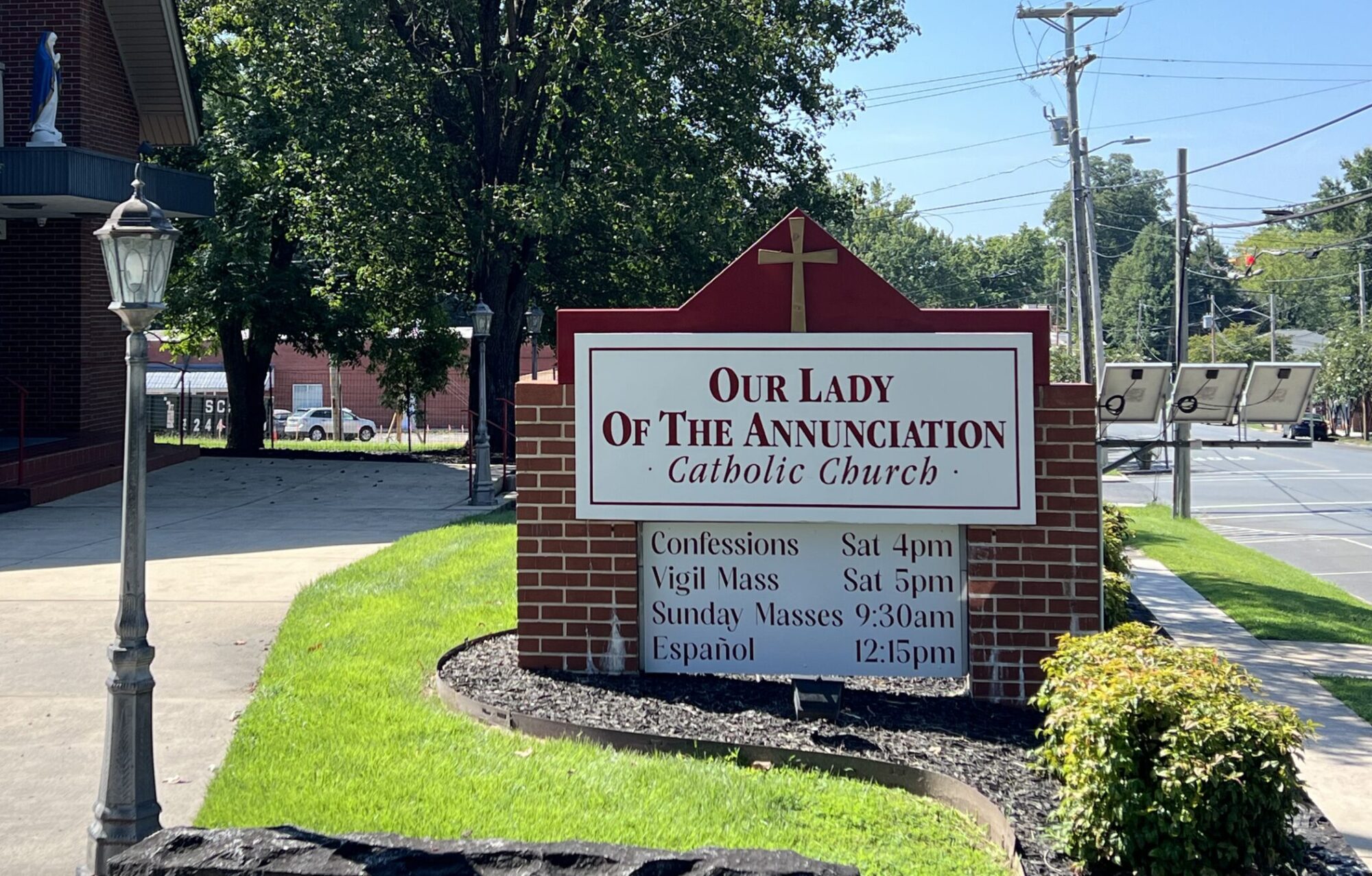
You can read all of Father Fitzgibbons’ sermons by going to annunciationcatholicalbemarle.com and clicking on “Blog” then “Categories” and then “Sermon Notes.”  On a cell phone: click on “Blog” then “Menu” and then “Categories.”  Sermon Notes are also available on the church Facebook page at ola.catholic.church.  Click on “Groups” and then “Sermon Notes.”


The Catechism in a Year – Day 143 – Amen

Congratulations, we have come to the conclusion of Part One of the Catechism! Fr. Mike reviews the last “nugget” section on death and judgment, inviting us to regularly ponder the moment of our own death and judgment before our Lord. We conclude today with an explanation of the meaning of the word “amen” and the significance it has for our belief in God. Today’s readings are Catechism paragraphs 1051-1065.

Click on link to play video: https://youtu.be/T7BRPkg1BAY


Saint of the Day – May 23 – Saint Gregory VII

Saint Gregory VII’s Story (c. 1025 – May 25, 1085)

The 10th century and the first half of the 11th were dark days for the Church, partly because the papacy was the pawn of various Roman families. In 1049, things began to change when Pope Leo IX, a reformer, was elected. He brought a young monk named Hildebrand to Rome as his counselor and special representative on important missions. Hildebrand was to become Gregory VII.

Three evils plagued the Church then: simony–the buying and selling of sacred offices and things; the unlawful marriage of the clergy; and lay investiture—kings and nobles controlling the appointment of Church officials. To all of these Hildebrand directed his reformer’s attention, first as counselor to the popes and later as pope himself.

Gregory’s papal letters stress the role of the bishop of Rome as the vicar of Christ and the visible center of unity in the Church. He is well known for his long dispute with Holy Roman Emperor Henry IV over who should control the selection of bishops and abbots.

Gregory fiercely resisted any attack on the liberty of the Church. For this he suffered and finally died in exile. He said, “I have loved justice and hated iniquity; therefore, I die in exile.” Thirty years later the Church finally won its struggle against lay investiture. The liturgical feast of Saint Gregory VII is celebrated on May 25.

Reflection

The Gregorian Reform, a milestone in the history of Christ’s Church, was named after this man who tried to extricate the papacy and the whole Church from undue control by civil rulers. Against an unhealthy Church nationalism in some areas, Gregory reasserted the unity of the whole Church based on Christ, and expressed in the bishop of Rome, the successor of Saint Peter.


Saint of the Day – May 22 – Saint Rita of Cascia

Saint Rita of Cascia’s Story (1381 – May 22, 1457)

Like Elizabeth Ann Seton, Rita of Cascia was a wife, mother, widow, and member of a religious community. Her holiness was reflected in each phase of her life.

Born at Roccaporena in central Italy, Rita wanted to become a nun but was pressured at a young age into marrying a harsh and cruel man. During her 18-year marriage, she bore and raised two sons. After her husband was killed in a brawl and her sons had died, Rita tried to join the Augustinian nuns in Cascia. Unsuccessful at first because she was a widow, Rita eventually succeeded.

Over the years, her austerity, prayerfulness, and charity became legendary. When she developed wounds on her forehead, people quickly associated them with the wounds from Christ’s crown of thorns. She meditated frequently on Christ’s passion. Her care for the sick nuns was especially loving. She also counseled lay people who came to her monastery.

Beatified in 1626, Rita was not canonized until 1900. She has acquired the reputation, together with Saint Jude, as a saint of impossible cases. Many people visit her tomb each year.

Reflection

Although we can easily imagine an ideal world in which to live out our baptismal vocation, such a world does not exist. An “If only ….” approach to holiness never quite gets underway, never produces the fruit that God has a right to expect.

Rita became holy because she made choices that reflected her baptism and her growth as a disciple of Jesus. Her overarching, lifelong choice was to cooperate generously with God’s grace, but many small choices were needed to make that happen. Few of those choices were made in ideal circumstances—not even when Rita became an Augustinian nun.

Saint Rita of Cascia is the Patron Saint of:

Difficult Marriages
Impossible Causes
Infertility
Parenthood


Saint of the Day – May 21 – Saint Cristóbal Magallanes and Companions

Saint Cristóbal Magallanes and Companions’ Story
(July 30, 1869-May 25, 1927; Companions d. between 1915 and 1937)

Like Blessed Miguel Agustín Pro, SJ, Cristóbal and his 24 companion martyrs lived under a very anti-Catholic government in Mexico, one determined to weaken the Catholic faith of its people. Churches, schools, and seminaries were closed; foreign clergy were expelled. Cristóbal established a clandestine seminary at Totatiche, Jalisco. He and the other priests were forced to minister secretly to Catholics during the presidency of Plutarco Calles (1924-28).

All of these martyrs except three, were diocesan priests. David, Manuel and Salvador were laymen who died with their parish priest, Luis Batis. They all belonged to the Cristero movement, pledging their allegiance to Christ and to the Church that he established, to spread the Good News in society—even if Mexico’s leaders had made it a crime to receive baptism or celebrate the Mass.

These martyrs did not die as a single group but over 22 years time in eight Mexican states, with Jalisco and Zacatecas having the largest number. They were beatified in 1992 and canonized eight years later.

Reflection

Every martyr realizes how to avoid execution, but refuses to pay the high price of doing so. A clear conscience was more valuable than a long life. We may be tempted to compromise our faith while telling ourselves that we are simply being realistic, dealing with situations as we find them. Is survival really the ultimate value? Do our concrete, daily choices reflect our deepest values, the ones that allow us to “tick” the way we do? Anyone can imagine situations in which being a follower of Jesus is easier than the present situation. Saints remind us that our daily choices, especially in adverse circumstances, form the pattern of our lives.


Saint of the Day – May 20 – Saint Bernardine of Siena

Saint Bernardine of Siena’s Story (September 8, 1380 – May 20, 1444)

Most of the saints suffer great personal opposition, even persecution. Bernardine, by contrast, seems more like a human dynamo who simply took on the needs of the world.

He was the greatest preacher of his time, journeying across Italy, calming strife-torn cities, attacking the paganism he found rampant, attracting crowds of 30,000, following Saint Francis of Assisi’s admonition to preach about “vice and virtue, punishment and glory.”

Compared with Saint Paul by the pope, Bernardine had a keen intuition of the needs of the time, along with solid holiness and boundless energy and joy. He accomplished all this despite having a very weak and hoarse voice, miraculously improved later because of his devotion to Mary.

When he was 20, the plague was at its height in his hometown of Siena. Sometimes as many as 20 people died in one day at the hospital. Bernardine offered to run the hospital and, with the help of other young men, nursed patients there for four months. He escaped the plague, but was so exhausted that a fever confined him for several months. He spent another year caring for a beloved aunt whose parents had died when he was a child, and at her death began to fast and pray to know God’s will for him.

At 22, he entered the Franciscan Order and was ordained two years later. For almost a dozen years he lived in solitude and prayer, but his gifts ultimately caused him to be sent to preach. He always traveled on foot, sometimes speaking for hours in one place, then doing the same in another town.

Especially known for his devotion to the Holy Name of Jesus, Bernardine devised a symbol—IHS, the first three letters of the name of Jesus in Greek—in Gothic letters on a blazing sun. This was to displace the superstitious symbols of the day, as well as the insignia of factions: for example, Guelphs and Ghibellines. The devotion spread, and the symbol began to appear in churches, homes and public buildings. Opposition arose from those who thought it a dangerous innovation. Three attempts were made to have the pope take action against him, but Bernardine’s holiness, orthodoxy, and intelligence were evidence of his faithfulness.

General of the Friars of the Strict Observance, a branch of the Franciscan Order, Bernardine strongly emphasized scholarship and further study of theology and canon law. When he started there were 300 friars in the community; when he died there were 4,000. He returned to preaching the last two years of his life, dying while traveling.

Reflection

Another dynamic saint once said, “…I will not be a burden, for I want not what is yours, but you…. I will most gladly spend and be utterly spent for your sakes” (2 Corinthians 12:14). There is danger that we see only the whirlwind of activity in the Bernardines of faith—taking care of the sick, preaching, studying, administering, always driving—and forget the source of their energy. We should not say that Bernardine could have been a great contemplative if he had had the chance. He had the chance, every day, and he took it.

Saint Bernardine of Siena is the Patron Saint of:

Advertising
Gambling
Italy
Public Relations


Saint of the Day – May 19 – Saint Theophilus of Corte

Saint Theophilus of Corte’s Story (October 30, 1676 – June 17, 1740)

If we expect saints to do marvelous things continually and to leave us many memorable quotes, we are bound to be disappointed with Saint Theophilus. The mystery of God’s grace in a person’s life, however, has a beauty all its own.

Theophilus was born in Corsica of rich and noble parents. As a young man, he entered the Franciscans and soon showed his love for solitude and prayer. After admirably completing his studies, he was ordained and assigned to a retreat house near Subiaco. Inspired by the austere life of the Franciscans there, he founded other such houses in Corsica and Tuscany. Over the years, he became famous for his preaching as well as his missionary efforts.

Though he was always somewhat sickly, Theophilus generously served the needs of God’s people in the confessional, in the sickroom, and at the graveside. Worn out by his labors, he died on June 17, 1740. He was canonized in 1930.

Reflection

There is a certain dynamism in all the saints that prompts them to find ever more selfless ways of responding to God’s grace. As time went on, Theophilus gave more and more single-hearted service to God and to God’s sons and daughters. Honoring the saints will make no sense unless we are thus drawn to live as generously as they did. Their holiness can never substitute for our own.


The Catechism in a Year – Day 142 – The New Heaven and the New Earth

What will happen to humanity and the entire universe at the end of time? Fr. Mike shares with us the joyous hope of the new heaven and the new earth that awaits us after the Last Judgment. We learn that “at the end of time, the Kingdom of God will come in its fullness,” and all of creation will be redeemed and renewed. There will be no more weeping, mourning, nor pain, for death shall be no more. Fr. Mike invites us to hold on to this hope as we struggle on this side of heaven and await this great promise. Today’s Catechism readings are paragraphs 1042-1050.

Click on link to play video: https://youtu.be/Du13k-DScKs


The Catechism in a Year – Day 141 – The Last Judgment

We delve into the cosmic event that will take place at the end of time known as the Last Judgment. Fr. Mike explains the difference between the Last Judgment and our particular judgment at the time of our death. We learn that the Last Judgment will reveal the consequences of all our actions and how God’s justice triumphs over all the injustices we’ve committed and suffered. Fr. Mike emphasizes that the message of the Last Judgment is ultimately one of hope and conversion. Today’s readings are Catechism paragraphs 1038-1041.

Click on link to play video: https://youtu.be/ENDOLGqmO5g