Saint Charles Lwanga and Companions’ Story (d. between November 15, 1885 – January 27, 1887)
One of 22 Ugandan martyrs, Charles Lwanga is the patron of youth and Catholic action in most of tropical Africa. He protected his fellow pages, aged 13 to 30, from the homosexual demands of the Bagandan ruler, Mwanga, and encouraged and instructed them in the Catholic faith during their imprisonment for refusing the ruler’s demands.
Charles first learned of Christ’s teachings from two retainers in the court of Chief Mawulugungu. While a catechumen, he entered the royal household as assistant to Joseph Mukaso, head of the court pages.
On the night of Mukaso’s martyrdom for encouraging the African youths to resist Mwanga, Charles requested and received baptism. Imprisoned with his friends, Charles’s courage and belief in God inspired them to remain chaste and faithful.
For his own unwillingness to submit to the immoral acts and his efforts to safeguard the faith of his friends, Charles was burned to death at Namugongo on June 3, 1886, by Mwanga’s order.
When Pope Paul VI canonized these 22 martyrs on October 18, 1964, he also made reference to the Anglican pages martyred for the same reason.
Reflection
Like Charles Lwanga, we are all teachers and witnesses to Christian living by the examples of our own lives. We are all called upon to spread the word of God, whether by word or deed. By remaining courageous and unshakable in our faith during times of great moral and physical temptation, we live as Christ lived.
Marcellinus and Peter were prominent enough in the memory of the Church to be included among the saints of the Roman Canon. Mention of their names is optional in our present Eucharistic Prayer I.
Marcellinus was a priest and Peter was an exorcist, that is, someone authorized by the Church to deal with cases of demonic possession. They were beheaded during the persecution of Emperor Diocletian. Pope Damasus wrote an epitaph apparently based on the report of their executioner, and Constantine erected a basilica over the crypt in which they were buried in Rome. Numerous legends sprang from an early account of their death.
Reflection
Why are these men included in our Eucharistic prayer, and given their own feast day, in spite of the fact that almost nothing is known about them? Probably because the Church respects its collective memory. They once sent an impulse of encouragement through the whole Church. They made the ultimate step of faith.
The Catechism makes clear to us that evangelization and the sacraments go hand in hand. An ancient saying is highlighted, linking the two: lex orandi, lex credendi—or, the law of prayer is the law of faith. Fr. Mike illustrates this connection by showing us that, when you change the sign that points to an invisible reality, you risk changing where it’s pointing. This is why “no sacramental rite may be modified or manipulated at the will of the minister or the community.” Today’s readings are Catechism paragraphs 1122-1126.
Justin never ended his quest for religious truth even when he converted to Christianity after years of studying various pagan philosophies.
As a young man, he was principally attracted to the school of Plato. However, he found that the Christian religion answered the great questions about life and existence better than the philosophers.
Upon his conversion he continued to wear the philosopher’s mantle, and became the first Christian philosopher. He combined the Christian religion with the best elements in Greek philosophy. In his view, philosophy was a pedagogue of Christ, an educator that was to lead one to Christ.
Justin is known as an apologist, one who defends in writing the Christian religion against the attacks and misunderstandings of the pagans. Two of his so-called apologies have come down to us; they are addressed to the Roman emperor and to the Senate.
For his staunch adherence to the Christian religion, Justin was beheaded in Rome in 165.
Reflection
As patron of philosophers, Justin may inspire us to use our natural powers—especially our power to know and understand—in the service of Christ, and to build up the Christian life within us. Since we are prone to error, especially in reference to the deep questions concerning life and existence, we should also be willing to correct and check our natural thinking in light of religious truth. Thus we will be able to say with the learned saints of the Church: I believe in order to understand, and I understand in order to believe.
Remember last week I talked to you about the Ascension and how the human nature our good Lord took from the Blessed Mother was assumed into His divine nature. It’s the same nature that He suffered with, healed with, died with, was resurrected with, and took to Heaven. So, if Christ’s human nature is in Heaven, how does He continue to do His work in the world? Fair question. Well, He takes our human natures and uses them. Through the Holy Spirt, He takes all our human natures and forms His new Body which is the Church. With His new Body, He continues to teach, sanctify, heal, and bring His love to the world. His new Body will continue for generations until the end of the world. In the Book of Acts, our Lord says, “Paul, why are you persecuting Me? He didn’t say, “the church” or “a Christian Group.” He said, “Why are you persecuting Me?” He said, “Me” personally because we are a part of His body.
All those who are baptized are baptized in Christ. You are part of His new body extended throughout the Ages. That’s why it’s blasphemy when someone says, “Oh, I am reconciled to God but not His Church” or they say, “I love God but not the Church.” Absolute blasphemy. You love the head but not the body. That makes no sense. You cannot love one without the other. It’s a whole Person . . . a package deal. Christ takes our human natures which are offered by us or by our parents at our Baptism. He assumes our human natures into His new Body to become whatever part of His Body that represents our vocation to bring God’s word to others, to heal, teach, and sanctify. Whatever the vocation, Holy Orders, Religious, married life, or lay life – whatever part of His Body – we are called to build it up.
Christ uses our human nature to reach out and to bring His love to the world . . . to speak the universal language At Pentecost, Peter spoke to the crowd, and everyone heard him in their own language. Everyone hears the language of Christ. Now, I am not gifted in tongues. If you have ever been to the 12:15 Mass, you know that I do not have that gift. I speak Spanish with French accent. French is my second language. Believe it or not, I took Intermediate Conversational French in college, but my aunt who is 95 years old corrects my French. I had to relearn French because my family was French Canadian and did not speak the French you learn in books which is Parisian. While I cannot speak many languages, I know a priest who speaks five of them. We are all called, and we are all able, to speak the most important language – a language nobody hears – and that’s the language of love and of Christ living in the world. Whatever vocation and whatever circumstance in which you find yourself, bring Christ in. Be the Good Samaritan. Everybody sees that love. Everybody can translate that language . . . . the universal language of Christ.
I’ve told you this story before. I don’t have that many years left as a priest, so I’ll share with you the stories I’ve got. One day I was making my rounds in hospice at the VA, and two EMT’s wheeled in a patient. They wanted to know which room the patient was going in. The nurses were busy, so I told them and went down to the room with them. To transfer a patient onto the bed, it really takes three people. One to grab the sheet, another to hold the head, and another to hold the feet. Since there were only two EMT’s, I helped transfer the patient by holding his feet. After we moved him, I went to the sink to wash my hands since I hadn’t used gloves. One of the EMT’s who had been fairly rude to me earlier came over and said, “Thank you, Father.” It was a big change from when they first came in even though I hadn’t done anything special. One time a nurse asked me if I would help clean out a trachea tube which is not a real fun thing to do if you don’t have a strong stomach. Sure. “What did you do after that, Father?” Lunch. Cleaning the trachea tube didn’t bother me, and a man’s got to eat. Anything you do to help someone, those acts of love, will be noticed. They are things we do instinctively and perhaps with no forethought at all. Something as simple as helping somebody with their shopping cart at Walmart by putting the cart back in its proper place so that it doesn’t go careening through the parking lot. People will see those little acts of love. It truly makes a difference because nowadays it’s so unusual. But we are all called to do this as members of Christ’s Body.
We are called to teach, evangelize, and to build up His Body which is His Church. You were given the gift of tongue in Baptism because you were brought into the Body of Christ. The gift of tongue is not a bunch of babbling. Get some medicine, and you’ll be fine. You don’t have to be a linguist . . . you have to be holy. The gift of tongue is the gift of love by which we bring Christ’s love to the world. God can work through even such a sinful creature as I am to bring Christ’s love and goodness to people. You are no different than me – except better looking – God’s grace enables us to speak that one beautiful language of the Holy Spirit which is Christ and love. And when people ask you how you can do that, you can tell them the reason is your Faith. By the way, the reason is a Who and not a what. So do those small acts of love; they always have an effect. You never know.
Father’s Reflections . . .
I learned from a highly placed, confidential source that things are crazy at Walmart. It is Memorial Day weekend, and you can get great deals on all sorts of stuff like cars, mattresses, linens, appliances, and furniture. It makes me so proud that I fought for our country!
How will you apply this message to your life? ___________________________
You can read all of Father Fitzgibbons’ sermons by going to annunciationcatholicalbemarle.com and clicking on “Blog” then “Categories” then “Sermon Notes.” On a cell phone: click on “Blog” then “Menu” and then “Categories.” Sermon Notes are also available on the church Facebook page at ola.catholic.church. Click on “Groups” and then “Sermon Notes.”
The Story of the Visitation of the Blessed Virgin Mary
This is a fairly late feast, going back only to the 13th or 14th century. It was established widely throughout the Church to pray for unity. The present date of celebration was set in 1969, in order to follow the Annunciation of the Lord and precede the Nativity of Saint John the Baptist.
Like most feasts of Mary, it is closely connected with Jesus and his saving work. The more visible actors in the visitation drama (see Luke 1:39-45) are Mary and Elizabeth. However, Jesus and John the Baptist steal the scene in a hidden way. Jesus makes John leap with joy—the joy of messianic salvation. Elizabeth, in turn, is filled with the Holy Spirit and addresses words of praise to Mary—words that echo down through the ages.
It is helpful to recall that we do not have a journalist’s account of this meeting. Rather Luke, speaking for the Church, gives a prayerful poet’s rendition of the scene. Elizabeth’s praise of Mary as “the mother of my Lord” can be viewed as the earliest Church’s devotion to Mary. As with all authentic devotion to Mary, Elizabeth’s (the Church’s) words first praise God for what God has done to Mary. Only secondly does she praise Mary for trusting God’s words.
Then comes the Magnificat (Luke 1:46-55). Here, Mary herself—like the Church—traces all her greatness to God.
Reflection
One of the invocations in Mary’s litany is “Ark of the Covenant.” Like the Ark of the Covenant of old, Mary brings God’s presence into the lives of other people. As David danced before the Ark, John the Baptist leaps for joy. As the Ark helped to unite the 12 tribes of Israel by being placed in David’s capital, so Mary has the power to unite all Christians in her son. At times, devotion to Mary may have occasioned some divisiveness, but we can hope that authentic devotion will lead all to Christ and therefore, to one another.
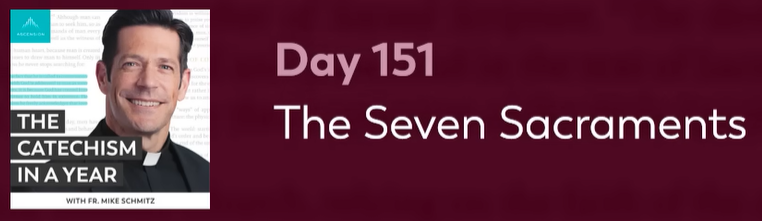
The Catechism introduces the seven sacraments that Christ offers the Church: Baptism, Confirmation, Eucharist, Reconciliation, Anointing of the Sick, Holy Orders, and Matrimony. The Catechism highlights the fact that the sacraments are “by the Church” because the Church is “Christ’s action at work”, and they are “for the Church” because they “manifest and communicate to men…the mystery of communion with the God who is love.” Fr. Mike focuses on the fact that while ministerial priests administer many of the sacraments, their priesthood is at the service of the baptismal priesthood, into which all of the baptized are ordained. Today’s readings are from Catechism paragraphs 1113-1121.
Today Fr. Mark-Mary shares a challenging word for us about excusing our sins while being critical of other’s sins. We need to grow in docility to follow God’s commands for the moral life instead of making excuses for our sin.
“If I speak in the tongues of men and of angels, but have not love, I am a noisy gong or a clanging cymbal.”
Speak the Truth in Love
What is the relationship between truth and love? Today, Jeff dives into the books of Corinthians and Ephesians and shares what Paul teaches on how to love and the importance of love. Jeff explains what true love looks like and what it results in.
Have you ever heard someone say that “social justice” is not Christian? Today, Fr. Josh addresses the topic of “social justice” and whether or not it is Christian. He also responds to the use of social media and the discernment one should use when sharing thoughts and ideas on those platforms.