Saint Maria Goretti’s Story (October 16, 1890 – July 6, 1902)
One of the largest crowds ever assembled for a canonization—250,000—symbolized the reaction of millions touched by the simple story of Maria Goretti. She was the daughter of a poor Italian tenant farmer, had no chance to go to school, never learned to read or write. When Maria made her First Communion not long before her death, she was one of the larger and somewhat backward members of the class.
On a hot afternoon in July, Maria was sitting at the top of the stairs of her house, mending a shirt. She was not quite 12 years old, but physically mature. A cart stopped outside, and a neighbor, 18-year-old Alessandro, ran up the stairs. He seized her and pulled her into a bedroom. She struggled and tried to call for help. “No, God does not wish it,” she cried out. “It is a sin. You would go to hell for it.” Alessandro began striking at her blindly with a long dagger.
Maria was taken to a hospital. Her last hours were marked by the usual simple compassion of the good—concern about where her mother would sleep, forgiveness of her murderer (she had been in fear of him, but did not say anything lest she cause trouble to his family), and her devout welcoming of Viaticum, her last Holy Communion. She died about 24 hours after the attack.
Alessandro was sentenced to 30 years in prison. For a long time he was unrepentant and surly. One night he had a dream or vision of Maria gathering flowers and offering them to him. His life changed. When he was released after 27 years, his first act was to beg the forgiveness of Maria’s mother.
Devotion to the young martyr grew, miracles were worked, and in less than half a century she was canonized. At her beatification in 1947, her 82-year-old mother, two sisters, and her brother appeared with Pope Pius XII on the balcony of St. Peter’s. Three years later, at Maria’s canonization, a 66-year-old Alessandro Serenelli knelt among the quarter-million people and cried tears of joy.
Reflection
Maria may have had trouble with catechism, but she had no trouble with faith. God’s will was holiness, decency, respect for one’s body, absolute obedience, total trust. In a complex world, her faith was simple: It is a privilege to be loved by God, and to love him—at any cost.
Saint Anthony Zaccaria’s Story (1502 – July 5, 1539)
At the same time that Martin Luther was attacking abuses in the Church, a reformation within the Church was already being attempted. Among the early movers of the Counter-Reformation was Anthony Zaccaria. His mother became a widow at 18, and devoted herself to the spiritual education of her son. He received a medical doctorate at 22, and while working among the poor of his native Cremona in Italy, was attracted to the religious apostolate. He renounced his rights to any future inheritance, worked as a catechist, and was ordained a priest at the age of 26. Called to Milan in a few years, he laid the foundations of three religious congregations, one for men, one for women, and an association of married couples. Their aim was the reform of the decadent society of their day, beginning with the clergy, religious, and lay people.
Greatly inspired by Saint Paul—his congregation is named the Barnabites, after the companion of that saint—Anthony preached with great vigor in church and street, conducted popular missions, and was not ashamed of doing public penance.
Anthony encouraged such innovations as the collaboration of the laity in the apostolate, frequent Communion, the Forty Hours devotion, and the ringing of church bells at 3:00 p.m. on Fridays. His holiness moved many to reform their lives, but as with all saints, it also moved many to oppose him. Twice his community had to undergo official religious investigation, and twice it was exonerated.
While on a mission of peace, Anthony became seriously ill and was brought home for a visit to his mother. He died at Cremona at the age of 36.
Reflection
The austerity of Anthony’s spirituality and the Pauline ardor of his preaching would probably “turn off” many people today. When even some psychiatrists complain at the lack of a sense of sin, it may be time to tell ourselves that not all evil is explained by emotional disorder, subconscious and unconscious drives, parental influence, and so on. The old-time “hell and damnation” mission sermons have given way to positive, encouraging, biblical homilies. We do indeed need assurance of forgiveness, relief from existential anxiety, and future shock. But we still need prophets to stand up and tell us, “If we say ‘We are without sin,’ we deceive ourselves and the truth is not in us” (1 John 1:8).
Saint Elizabeth of Portugal’s Story (1271 – July 4, 1336)
Elizabeth is usually depicted in royal garb with a dove or an olive branch. At her birth in 1271, her father Pedro III, future king of Aragon, was reconciled with his father James, the reigning monarch. This proved to be a portent of things to come. Under the healthful influences surrounding her early years, she quickly learned self-discipline and acquired a taste for spirituality.
Thus fortunately prepared, Elizabeth was able to meet the challenge when at the age of 12, she was given in marriage to Denis, king of Portugal. She was able to establish for herself a pattern of life conducive to growth in God’s love, not merely through her exercises of piety, including daily Mass, but also through her exercise of charity, by which she was able to befriend and help pilgrims, strangers, the sick, the poor—in a word, all those whose need came to her notice. At the same time she remained devoted to her husband, whose infidelity to her was a scandal to the kingdom.
Denis, too, was the object of many of her peace endeavors. Elizabeth long sought peace for him with God, and was finally rewarded when he gave up his life of sin. She repeatedly sought and effected peace between the king and their rebellious son Alfonso, who thought that he was passed over to favor the king’s illegitimate children. She acted as peacemaker in the struggle between Ferdinand, king of Aragon, and his cousin James, who claimed the crown. And finally from Coimbra, where she had retired as a Franciscan tertiary to the monastery of the Poor Clares after the death of her husband, Elizabeth set out and was able to bring about a lasting peace between her son Alfonso, now king of Portugal, and his son-in-law, the king of Castile.
Reflection
The work of promoting peace is anything but a calm and quiet endeavor. It takes a clear mind, a steady spirit and a brave soul to intervene between people whose emotions are so aroused that they are ready to destroy one another. This is all the more true of a woman in the early 14th century. But Elizabeth had a deep and sincere love and sympathy for humankind, an almost total lack of concern for herself, and an abiding confidence in God. These were the tools of her success.
When I prepare couples for marriage, I don’t ask them if they have learned how to talk to one another. No . . . I’m not Doctor Phil. I wanted to be Doctor House, but I’m definitely not Doctor Phil. The whole basis of marriage, a vocation, is love of God. Be holy and perfect and all things will be given to you. Our Lord tells us being holy is first and foremost because you cannot give what you do not have. When we are united with the Source of love, we can give that love to others. All love comes from the Father because He is love itself. And that is what I tell couples. If you want to have a marriage that lasts and survives the rotten times, be holy. However, good times can be rotten too, and you should be wary of them.
I also tell couples to pray the Rosary together every night. “Father, what if they are not Catholic?” Well, the good news is that they are praying the Rosary. The bad news is that it ain’t going to hurt a bit. There is no downside. If you pray the Rosary together, you can talk to each other about anything. I got that from Bishop Sheen by the way. I’m not that bright. You need to be united to the Source of life. “But Father, you are not married.” I could not do that to a woman although my brother did, and he had a Mensa card.
Each vocation is manifested in love to the Sacred Body of Christ – the Church. In my 39 years of priesthood, I have seen so many priests and religious leave the vocation because they do not, and will not, give themselves totally to God. “My work is my prayer.” No, it’s not. Those are two different words. I know because I went to Catholic school. They are spelled differently and mean different things. Both can be acts of love, but you cannot give what you do not have. So, you must return to and be united with the Source of love. Remember, in Scripture, Christ said, “Come away and spend time with God.” The religious and priests become disheartened, and they leave. They go looking for love in all the wrong places. They look for love in people, places, and things. Some do come back, which is tough because they don’t want to admit their mistakes. But that Love they once touched won’t give up and follows them. The faithful are united with the source of God’s love and seek Him by immersing themselves in His love through the Sacraments. This is where we get the strength to do what God asks of us – to do corporal and spiritual works of mercy.
We always like it when people thank us for our good works, but most people don’t. “Well, Father, you do good works.” I hope so; I’m going to be judged on that. “So, people must thank you a lot.” No, not really. I’ve performed a lot of funerals and weddings and did not even get a thank you note. Doing weddings is like negotiating with terrorists. They come in with a list of nonnegotiable demands. This is my Church, and I appreciate your desire to have your wedding here, but we don’t do that here. “Well, father so and so does it.” That’s nice. Here are the rules straight from the Church’s rulebook. Many people don’t say “thank you.” Although we do it for Christ, I would love to get a “thank you” especially for the staff here who work so hard.
Our feelings get hurt when people don’t say “thank you” and appreciate the enormity of our stooping down from our greatness to help them. However, we humbly do it for Christ, and people see Christ in our human natures. It’s tough sometimes. Because you are hurt, you really want to say some good old Anglo-Saxon words that shouldn’t be used in polite company. But Christ says, “You gave a gift of love to Me, and I will repay you according to My nature.” So do not worry about it. Bring Me your sorrows. Bring Me your rejections. Bring Me your feelings of being unappreciated. Bring them to Me and stay awhile. You will learn how unappreciated I am for My gift of love. I offer Myself to the world in the Blessed Sacraments and look at how few show up. Look at how few say, “thank you.” People haven’t finished singing my praises and they begin leaving the church. Whoa! Did I dismiss you? No! They can’t wait to leave even though there’s not much going on in Albemarle at 10:30 in the morning.
Once I had a funeral here, and it was on a day like this. After the funeral, we got into the car to drive to the cemetery. We drove at a funeral pace, so we were not traveling very fast. I had the robes on, and I was very thirsty. But when you are in a hearse and in a funeral procession, you really can’t ask the driver to stop at a gas station so you can grab a Coke. That would be in poor taste and really frowned upon. I got to the church – and it was a beautiful church – if you don’t know where it is, you’ll never find it. It’s up over a hill and back. I got out of the hearse and began walking to the grave site. And there was this big, old man in bib overalls coming toward me with a cup in his hand. He said, “I thought you might like this.” It was a cup of ice-cold water. He is now resting with his family in the back of the church grounds. It was such a great act of love. How he knew that I would need it or if it was a simple act of courtesy and kindness, I don’t know. He did not know me, and I did not know him. As I talked to him, I realized that he was related to some of the parishioners here. But such as that. Always remember, when we do things for others, we are doing them for Christ.
Father’s Reflections . . . I looked at the calendar today, and I was reminded that 21 years ago I received an interesting letter. Know who it was from? The AARP. Know what made it so interesting? They sent it to me while I was in Iraq. So, we have geriatrics protecting our country. Great!
How will you apply this message to your life? ________________________________________
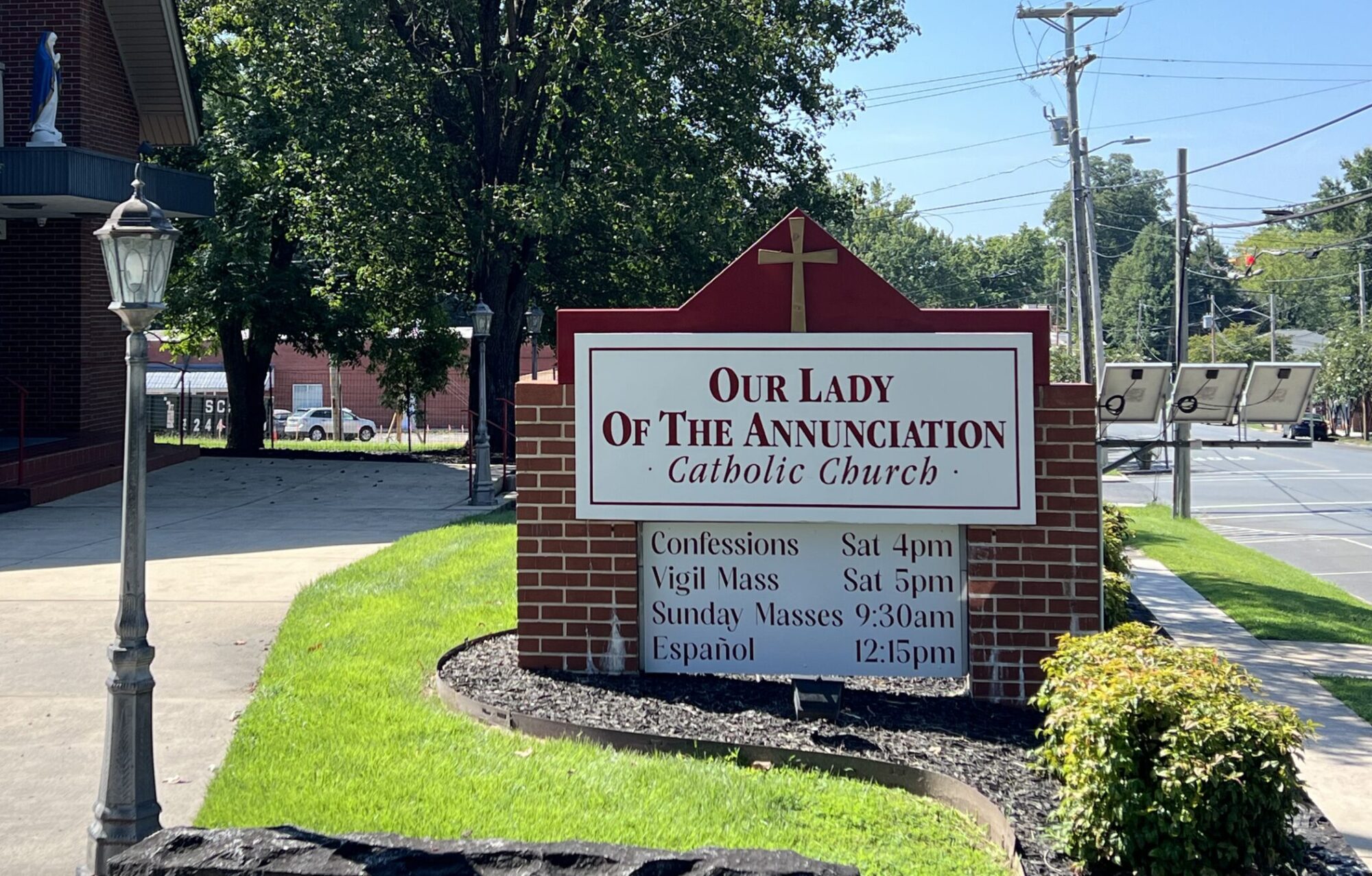
You can read all of Father Fitzgibbons’ sermons by going to annunciationcatholicalbemarle.com and clicking on “Blog” then “Categories” then “Sermon Notes.” On a cell phone: click on “Blog” and then “Menu.” Scroll to the bottom and click on “Categories.” Sermon Notes are also available on the church Facebook page at ola.catholic.church. Click on “Groups” and then “Sermon Notes.”
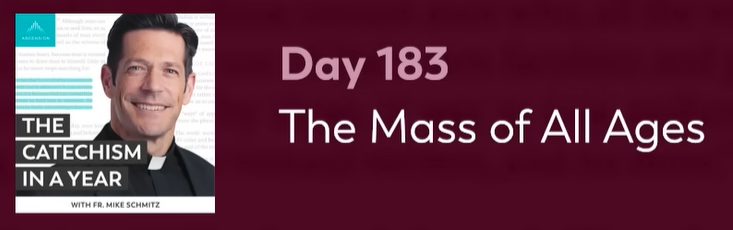
Celebrating the sacrament of the Eucharist has been part of the Tradition of the Catholic Church for 2,000 years. Fr. Mike unpacks the citation from St. Justin Martyr’s First Apology, which beautifully describes the structure of the Mass in AD 155 and captures how the Early Church had the same understanding of the Eucharist as we do today. Today’s readings are Catechism paragraphs 1341-1347.
Saint Charles Lwanga and Companions’ Story (d. between November 15, 1885 – January 27, 1887)
One of 22 Ugandan martyrs, Charles Lwanga is the patron of youth and Catholic action in most of tropical Africa. He protected his fellow pages, aged 13 to 30, from the homosexual demands of the Bagandan ruler, Mwanga, and encouraged and instructed them in the Catholic faith during their imprisonment for refusing the ruler’s demands.
Charles first learned of Christ’s teachings from two retainers in the court of Chief Mawulugungu. While a catechumen, he entered the royal household as assistant to Joseph Mukaso, head of the court pages.
On the night of Mukaso’s martyrdom for encouraging the African youths to resist Mwanga, Charles requested and received baptism. Imprisoned with his friends, Charles’s courage and belief in God inspired them to remain chaste and faithful.
For his own unwillingness to submit to the immoral acts and his efforts to safeguard the faith of his friends, Charles was burned to death at Namugongo on June 3, 1886, by Mwanga’s order.
When Pope Paul VI canonized these 22 martyrs on October 18, 1964, he also made reference to the Anglican pages martyred for the same reason.
Reflection
Like Charles Lwanga, we are all teachers and witnesses to Christian living by the examples of our own lives. We are all called upon to spread the word of God, whether by word or deed. By remaining courageous and unshakable in our faith during times of great moral and physical temptation, we live as Christ lived.
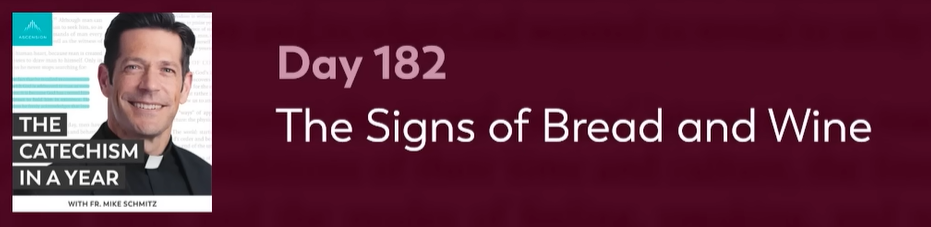
Fr. Mike breaks down the various ways the Eucharist fulfills the sacrifices of bread and wine of the Old Covenant and explains why the Eucharist is central to God’s plan of salvation. We learn that the Eucharist is a pledge of God’s love for each one of us and a tangible reminder that Jesus is always with us. Today’s readings are Catechism paragraphs 1333-1340.
The sacrament of the Eucharist has many different names, and “each name evokes certain aspects of it.” Fr. Mike explains the meaning behind this sacrament’s various titles, including; thanksgiving to God, the Lord’s Supper, Breaking of Bread, the Holy Sacrifice, Holy Mass, and others. All the names of this sacrament ultimately remind us that the Eucharist is both a noun and a verb. It is the Son’s great sacrifice to the Father and Jesus Christ himself. Today’s readings are Catechism paragraphs 1328-1332.
Saint Oliver Plunkett’s Story (November 1, 1629 – July 1, 1681)
The name of today’s saint is especially familiar to the Irish and the English—and with good reason. The English martyred Oliver Plunkett for defending the faith in his native Ireland during a period of severe persecution.
Born in County Meath in 1629, Oliver studied for the priesthood in Rome and was ordained there in 1654. After some years of teaching and service to the poor of Rome he was appointed Archbishop of Armagh in Ireland. Four years later, in 1673, a new wave of anti-Catholic persecution began, forcing Archbishop Plunkett to do his pastoral work in secrecy and disguise and to live in hiding. Meanwhile, many of his priests were sent into exile, schools were closed, Church services had to be held in secret, and convents and seminaries were suppressed. As archbishop, Plunkett was viewed as ultimately responsible for any rebellion or political activity among his parishioners.
Archbishop Plunkett was arrested and imprisoned in Dublin Castle in 1679, but his trial was moved to London. After deliberating for 15 minutes, a jury found him guilty of fomenting revolt. He was hanged, drawn, and quartered in July 1681.
Pope Paul VI canonized Oliver Plunkett in 1975.
Reflection
Stories like that of Oliver Plunkett seem to fit history. “Things like that don’t happen today” is often our thought. But they do. False accusations, prejudice, anti-Catholic sentiments, racism, sexism, etc. are still an active reality in our day. Perhaps a prayer to Saint Oliver for peace and justice might be appropriate.
Saint Junipero Serra’s Story (November 24, 1713 – August 28, 1784)
In 1776, when the American Revolution was beginning in the east, another part of the future United States was being born in California. That year a gray-robed Franciscan founded Mission San Juan Capistrano, now famous for its annually returning swallows. San Juan was the seventh of nine missions established under the direction of this indomitable Spaniard.
Born on Spain’s island of Mallorca, Serra entered the Franciscan Order taking the name of Saint Francis’ childlike companion, Brother Juniper. Until he was 35, he spent most of his time in the classroom—first as a student of theology and then as a professor. He also became famous for his preaching. Suddenly he gave it all up and followed the yearning that had begun years before when he heard about the missionary work of Saint Francis Solano in South America. Junipero’s desire was to convert native peoples in the New World.
Arriving by ship at Vera Cruz, Mexico, he and a companion walked the 250 miles to Mexico City. On the way Junipero’s left leg became infected by an insect bite and would remain a cross—sometimes life-threatening—for the rest of his life. For 18 years, he worked in central Mexico and in the Baja Peninsula. He became president of the missions there.
Enter politics: the threat of a Russian invasion south from Alaska. Charles III of Spain ordered an expedition to beat Russia to the territory. So the last two conquistadors—one military, one spiritual—began their quest. José de Galvez persuaded Junipero to set out with him for present-day Monterey, California. The first mission founded after the 900-mile journey north was San Diego in 1769 That year a shortage of food almost canceled the expedition. Vowing to stay with the local people, Junipero and another friar began a novena in preparation for St. Joseph’s day, March 19, the scheduled day of departure. On that day, the relief ship arrived.
Other missions followed: Monterey/Carmel (1770); San Antonio and San Gabriel (1771); San Luís Obispo (1772); San Francisco and San Juan Capistrano (1776); Santa Clara (1777); San Buenaventura (1782). Twelve more were founded after Serra’s death.
Junipero made the long trip to Mexico City to settle great differences with the military commander. He arrived at the point of death. The outcome was substantially what Junipero sought: the famous “Regulation” protecting the Indians and the missions. It was the basis for the first significant legislation in California, a “Bill of Rights” for Native Americans.
Because the Native Americans were living a nonhuman life from the Spanish point of view, the friars were made their legal guardians. The Native Americans were kept at the mission after baptism lest they be corrupted in their former haunts—a move that has brought cries of “injustice” from some moderns.
Junipero’s missionary life was a long battle with cold and hunger, with unsympathetic military commanders and even with danger of death from non-Christian native peoples. Through it all his unquenchable zeal was fed by prayer each night, often from midnight till dawn. He baptized over 6,000 people and confirmed 5,000. His travels would have circled the globe. He brought the Native Americans not only the gift of faith but also a decent standard of living. He won their love, as witnessed especially by their grief at his death. He is buried at Mission San Carlo Borromeo, Carmel, and was beatified in 1988. Pope Francis canonized him in Washington, D.C., on September 23, 2015.
Reflection
The word that best describes Junipero is zeal. It was a spirit that came from his deep prayer and dauntless will. “Always forward, never back” was his motto. His work bore fruit for 50 years after his death as the rest of the missions were founded in a kind of Christian communal living by the Indians. When both Mexican and American greed caused the secularization of the missions, the Chumash people went back to what they had been—God again writing straight with crooked lines.